
I used to really dislike spring.
Where we live, spring can feel like a funny in-between season — a stretch of weather that can never quite decide what it wants to be. Warm one day, cold the next. Sunny, then windy. Green and blooming, but still chilly enough to need a jacket.
I would often find myself in April…May….June just wanting to push past it and sink into the meat of summer — those predictable, even if brief, months of heat.
Predictable. That was the part I longed for.
Over the past month, I’ve been feeling the word acceptance rise to the surface. It’s a word I can struggle with, both personally and as a therapist, because it is so often confused with approval, condoning, or giving up.
But as I’ve sat with this word, I’ve been sensing into it differently.
Maybe acceptance is not saying, “I approve of what is happening.”
Maybe acceptance is the willingness to create enough space for what is happening so we are not constantly fighting against the current of our own lives.
There are certain areas of my life where acceptance can feel evasive — places where I notice myself pushing the same rock uphill again and again, determined, in some ways, to stay in the resistance and tension of what I wish were different.
And then there are areas where acceptance comes more freely. Where my mind and body seem more able to collaborate with reality. In those places, I often feel tension ease. Creativity becomes more available and my curiosity returns. There is more room to move in a way that feels optimistic, grounded, and resilient.
That tension between what was, what could be, what was hoped for, and what actually is can feel tenuous at times — not only in our minds, but in our bodies.
We may mentally dig our heels in and say:
No. I will not accept this.
This should not be happening.
If only this were different, then I could be different.
If only they changed, then I could feel okay.
If only life looked another way, then I could finally settle.
Of course, these are complicated statements. For many people in the world right now, if their basic needs were met, their lives would be profoundly different. Acceptance should never be used to minimize injustice, bypass grief, or ask people to tolerate harm.
But in the more ordinary and personal places where we find ourselves resisting reality, we may begin to notice how much energy goes toward trying to make the external world resolve what feels too hard to accept internally.
So, returning to what may seem like a small example: spring.
How do I begin to show up to spring differently?
I can still yearn for the predictability of long, warm summer days and nights. And I can carry a jacket with me. I can keep a hat nearby. I can support my body in being more comfortable with what is actually happening. I can stay hopeful in what’s to come.
I can also look around and orient to the season I am in: the green hillsides, the shimmering of aspen leaves in the spring wind, the buds bursting on trees and early flowers, and the symphony of birds that accompany my early morning, sunlit — albeit chilly and windy — walks.
Many truths can exist at once.
I can wish it were warmer, and I can notice beauty.
I can prefer summer, and I can orient to this day.
I can feel the discomfort of unpredictability, and I can still find beauty.
And how do we practice this with the more intense, grief-riddled areas of our lives?
When I think about the work I do with individuals and organizations, I often think about the cost of resistance — individually and relationally. The bracing, blaming, activation, and exhaustion that can come from denying ourselves the skill and gift of orienting to the present moment.
Orientation asks us to gently notice where we are in time and space. Maybe acceptance, in many ways, is emotional orientation:
What is the reality I am actually standing in right now?
Not the reality I wish I had.
Not the reality I thought I would have.
Not the reality I think I deserved.
But this one.
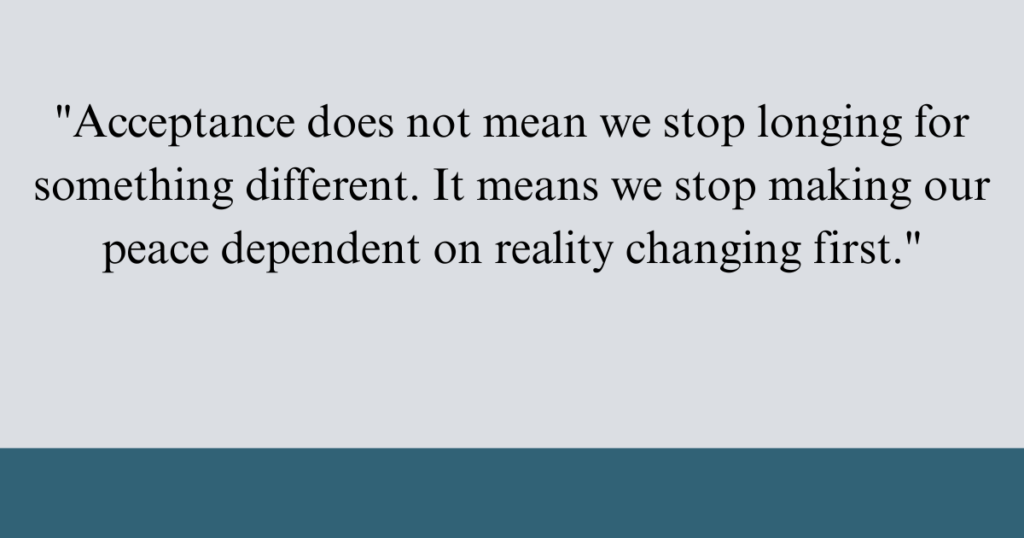
That does not mean we stop wanting change. It does not mean we stop advocating, grieving, setting boundaries, or taking meaningful action.
It means we stop abandoning the present moment while waiting for life to become more acceptable. And as we ask these questions, we can begin to track what happens in the body.
When you say to yourself, “This is the reality I am standing in right now,” what do you notice?
Does your body tighten?
Withdraw?
Heat up?
Tune out?
Want to argue?
Want to flee?
Want to soften?
Tracking matters.
It reminds us that acceptance is not simply a mindset or a one-time decision. It is a capacity we build. Sometimes our mind understands something long before our body feels safe enough to accept it.
And before we ask ourselves to accept reality, we may need to resource the parts of us that are terrified acceptance will break our hearts.
So perhaps acceptance begins gently.
Not with forcing ourselves to be okay.
Not with pretending something does not hurt.
Not with rushing toward peace before we have told the truth.
But with orienting.
I am here.
This is the season I am in.
This is what is true right now.
And I can look for one place of support as I meet it.
Acceptance does not remove pain from our lives. But it may reduce the suffering that comes from arguing with what is already here.
And sometimes, when we stop fighting the current of our lives, we find that more of ourselves becomes available — for care, for choice, for boundaries, for grief, for beauty, and for whatever next step is ours to take.
With care,
Laurie
Reflection Prompts
- What is one area of my life I am still arguing with internally?
- What do I fear would happen if I accepted this reality as true?
- What do I confuse acceptance with? Approval? Giving up? Forgiveness? Weakness? Losing hope?
- What is the difference between “I accept this” and “I like this”?
- Where do I feel resistance to acceptance in my body?
- If my resistance had a protective purpose, what might it be trying to protect me from feeling?
- What reality am I slowly being invited to orient toward?
- What becomes possible if I stop spending so much energy wishing this were different?
- What can I accept today without needing to accept everything all at once?
- What support or resource might help my body tolerate the truth of this season?
CRM/Nervous-System Prompts
- When I say, “This is my life right now,” what do I notice inside?
- Do I feel activation, withdrawal, incongruence, steadiness, or something else?
- Is there any place in my body that feels neutral or okay as I reflect on this?
- Can I look around the room and remind myself: “I am here, now, in this moment”? (colors, objects, counting)
- What happens if I place one hand somewhere supportive (gesture) and say, “I don’t have to like this to acknowledge it”?
- What is one resource I can bring in as I tell the truth about what is hard?
- Can I let two things be true at once: “This hurts, and I am here”?
- What is one small next step available from inside my Resilient Zone?